
Commercial Pilot Flight Time Requirements
One of the most common questions aspiring career pilots ask is: How much flight time do I need to become a commercial pilot? The answer depends on the type of training program you choose and how you log your flight hours along the way. At Paragon Flight, we specialize in helping students earn their Commercial Pilot License (CPL) efficiently, without sacrificing quality or safety.
To qualify for a CPL under FAA Part 61, the most common path, you must log at least 250 total flight hours, including:
- 100 hours as pilot-in-command (PIC)
- 50 hours of cross-country flight time
- 20 hours of flight training with an instructor
- 10 hours of instrument training
- 10 hours in a complex or Technically Advanced Aircraft (TAA)
- One cross-country flight of at least 300 nautical miles
- 5 hours of night VFR flight
Paragon Flight’s Part 61 pathway offers a flexible, self-paced option ideal for students balancing training with work, school, or family commitments. Our instructors collaborate with students to develop customized training schedules that fit their lifestyle while meeting all FAA requirements.
Looking for an Accelerated Path?
For students seeking a faster and more structured route, FAA Part 141 offers a more efficient option. Because of its rigorous, standardized curriculum, students can qualify for a CPL with just 190 flight hours. This pathway is ideal for:
- Full-time students
- International students eligible for M-1 visas
- Veterans using GI Bill benefits
- Anyone seeking a streamlined path to employment
Paragon Flight’s Part 141 curriculum is designed to minimize downtime and accelerate your progress while ensuring a high standard of safety and instruction.
After the CPL: Building Time Toward ATP
After earning a CPL, most pilots set their sights on the Airline Transport Pilot (ATP) certificate, which requires 1,500 total flight hours. One of the most effective ways to build these hours is by becoming a Certified Flight Instructor (CFI).
At Paragon Flight, many graduates continue to earn their CFII (Certified Flight Instructor – Instrument) and MEI (Multi-Engine Instructor) licensures. As instructors, they gain valuable paid experience while logging hours toward ATP eligibility. Many of our alumni also go on to work with regional airlines, charter services, and corporate aviation departments across the nation.
Why Train at Paragon Flight?
Paragon Flight combines expert instruction with industry-leading tools to deliver an efficient, real-world training experience. Our programs follow the Jeppesen curriculum, developed by Boeing, recognized for its structured, scenario-based approach that helps students progress with clarity and confidence.
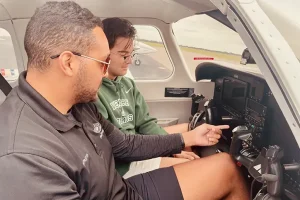
Our FAA-certified simulators, such as the ALSIM AL172, provide realistic flight scenarios from day one. Paragon students also train on a fleet of Technically Advanced Aircraft (TAA) equipped with Garmin G1000 and G3X Touch avionics, gaining hands-on experience with the systems used in today’s commercial and corporate aviation.
With campuses in Fort Myers and Punta Gorda, Florida, and LaGrange, Georgia, students benefit from over 300 days of ideal flying weather per year, keeping lessons and progression on schedule.
Are You Prepared for Takeoff?
Meeting commercial pilot flight time requirements is about logging hours in a structured, supportive, and high-quality training environment. At Paragon Flight, we provide the aircraft, instructors, and programs you need to take off with confidence.
Contact us today to speak with an advisor or schedule a tour at one of our campuses.